
A Turkey Farm Near Westerville, 1941
In college I was assigned to read a less well-known book by Kurt Vonnegut titled Slapstick. In the book, the main character has a revelation that Heaven is known as “The Turkey Farm” by its residents. The afterlife is called that because it is crowded, boring, and monotonous. If readers have ever seen a turkey farm, or seen one in the media, they will understand the comparison, regardless of theology.
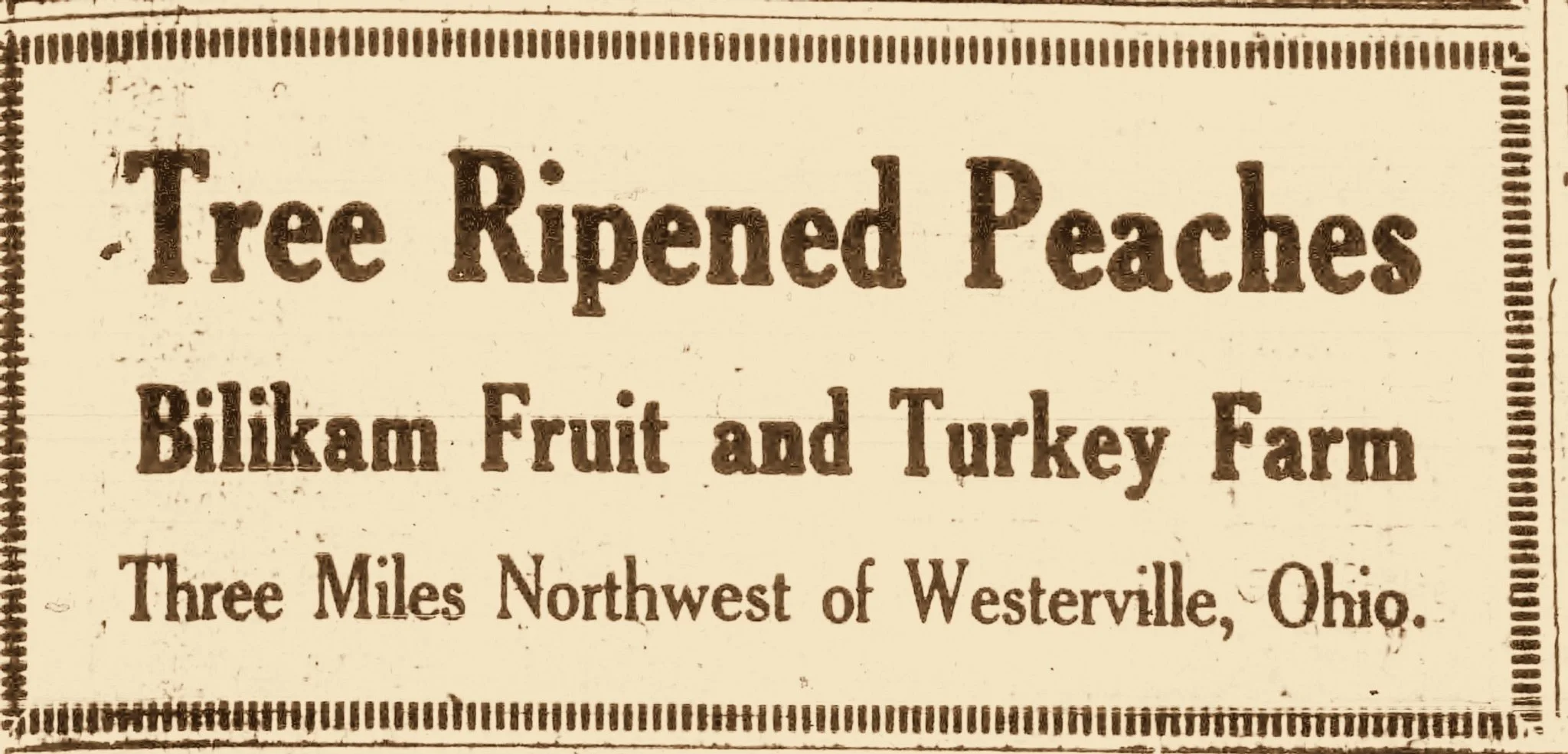
I do not believe that there are any turkey farms in Westerville; I’ve seen backyard chickens once or twice, but no turkeys. As recently as the 1940s, Westerville had a nearby turkey farm owned by Walter Bilikam. Bilikam (1897-1972), whose farm was on Clymer Road, raised and sold peaches, turkeys and other farm products. Undoubtedly, November was a busy time of year.
Walter Bilikam was a Columbus native, and had horticulture in his blood. Born in what is now Clintonville, his father Joseph Bilikam was listed as a “gardener” in the 1900 Census. Walter registered for the draft in World War 1. A faded picture of him appeared in the Columbus Dispatch, after a successful raccoon hunt. In 1929 his address was Galena, and he was selling racoon dogs., By 1930, he was married to Elma and had two children. They had by then moved to very near Westerville, giving their address as Orange Township, Delaware County. There he tended a peach orchard, and, perhaps to diversify his income over the calendar year, raised turkeys in season.
I’m not sure which came first, the peaches or the turkeys. The first advertisement for turkeys appeared in the Dispatch in 1941. That year yellow and white peaches were offered. In 1944, Bilikam advertised his “Fruit and Turkey Farm,” and added apples to the menu. By 1947, the farm was still advertising apples and peaches, but not turkeys.4 In 1950, the last decade of the census publicly viewable, Walter Bilikam was still doing “orchard work,” but seemed to be out of the turkey business.
Not every farmer lives out in the country. The Bilikam farm once served a semi-rural area that provided produce to a nearby urban area. Trouble is, urban sprawl has changed much “countryside” into repetitive tract housing, no longer suitable for turkeys, peaches, or anything agricultural. As to heaven, we will have to wait to see if the afterlife is like a turkey farm, and I am in no hurry!
- Alan Borer
Sources:
Columbus Dispatch, November 29, 1926.
Columbus Dispatch, November 10, 1941.
Ibid, October 29, 1944.
Ibid, September 5, 1947.