
Christmas Oratorio, 1917
Christmas music holds memories, or brings them back if they are forgotten. I still listen to (relatively) ancient Christmas LPs, not because of their musical brilliance, but because they remind me of Christmas’s past. Here in Westerville, the Christmas music-and-memory link is doubly true because of Benjamin Hanby and his legacy as the composer of “Up on the Housetop.” But there have been others, which await reentering our consciousness.
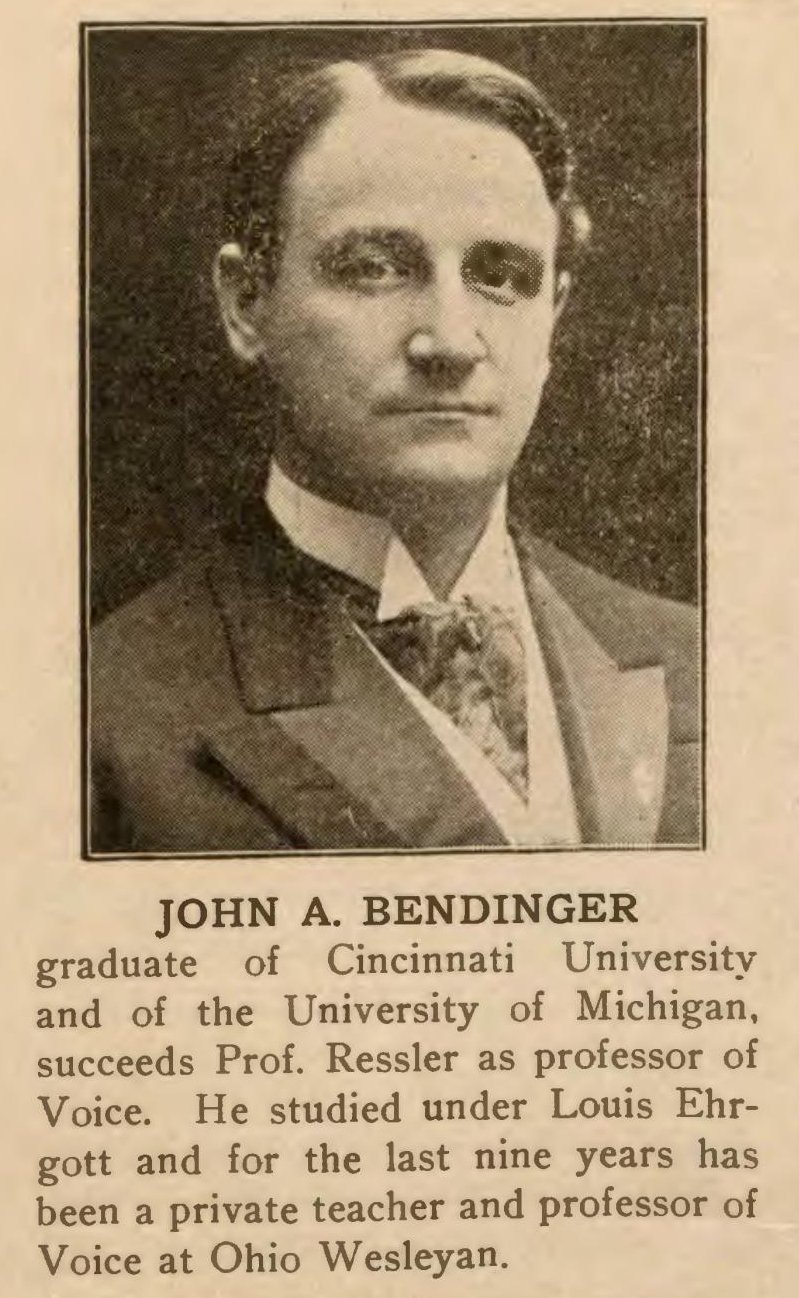
In 1915, and again in 1917, Westerville had a performance of a Christmas oratorio titled, “The New Born King.” Composed by Benjamin W. Loveland, a Connecticut insurance salesman who doubled as an organist and composer,[1] the Westerville performances were under the supervision of Otterbein’s then-Professor of Voice, John A. Bendinger. Professor Bendinger was not at Otterbein “for life” like many other faculty members. Of German parentage and a graduate of Cincinnati and the University of Michigan, he studied music with Louis Ehrgott, then spent nine years teaching at Ohio Wesleyan, while also teaching private students as well. He then took a teaching job at Otterbein[2]
Records show that Bendinger taught at Otterbein twice, a short term in 1903-5 and a longer tenure from 1912 to 1917. In both terms, he fulfilled the duties of a voice teacher: teaching music classes, choosing music, rehearsing, and leading performances. According to the Otterbein Review and its successor, the Tan and Cardinal, his performances were well received and had enthusiastic listeners.
We have no clue as to what attracted Bendinger to The New Born King, or why he offered it twice. It was a lengthy piece, needing various soloists and ensembles. It may be that after the 1915 performance, he simply repeated the offering because he knew it and did not want to learn an entirely new piece. Bendinger was getting ready to leave Otterbein after the 1917-18 Christmas break, and may not have had time to learn a whole new composition.
But the performance, held in the United Brethren Church on campus, was well received. “Everyone lauds the excellent work of the choir and the director, J. A. Bendinger,” crowed the Tan & Cardinal. Their review mentioned the time taken in preparation and the skill of the soloists. A campus production inevitably received glowing reviews, but even the Public Opinion gave the oratorio good reviews: “The United Brethren choir, numbering forty-members, gave a splendid Christmas concert Sunday evening. . . . under the direction of Prof. J. A. Bendinger.”[3]
As mentioned, John Bendinger left Otterbein in 1918. In 1920, he and his family were still living in Westerville, but his occupation was now ‘book-keeper,” hinting that he may have left the music business altogether.[4] By 1940, he and his wife Clotilde were living in Alameda County, California. The 1940 Census lists him as a laboratory assistant at an oil refinery.[5][6]
I have not been able to locate a recording of The New Born King, although a few libraries still have the sheet music.[7] I doubt that the oratorio will be made popular again from these few notes. But if you are looking for “Westerville Christmas” tunes, you could do worse than remember John A. Bendinger and his Christmas oratorio
- Alan Borer
[1] FindaGrave, "Benjamin Walter Loveland,” 123397857, accessed November 10, 2025.
[2] Otterbein Aegis, September 1913, p. 15.
[3] Westerville Public Opinion, December
[4] https://www.familysearch.org/ark:/61903/3:1:33SQ-GRXB-3CP?view=index&personArk=%2Fark%3A%2F 61903%2F1%3A1%3AMDBF-PT6&action=view&cc=1488411&lang=en&groupId=
[5] https://www.familysearch.org/ark:/61903/3:1:3QSQ-G9MT-3XMW?view=index&personArk=%2Fark%3A%
[6] F61903%2F1%3A1%3AK9QM-N74&action=view&cc=2000219&lang=en&groupId=
[7] https://acda-publications.s3.us-east-2.amazonaws.com/choral_journals/December_1989_Osborne_W.pdf ; https://lorenz.com/shop/church-choral/cantatas-and-musicals/the-newborn-king