
Mary Myrtle Metzger, Westerville Missionary
Mary Myrtle Metzger traveled far during her life, living in a time when many women traveled no further than the county seat. Metzger was a missionary, a missionary to one of the farthest places she could reach, the northern Philippines. Metzger left very few accounts of her impressive travels; what she did leave suggests a keen eye for the different peoples and cultures she experienced, yet with an unshaken belief in the rightness of the missionary cause. These are a few fragments of her story.
Metzger (1889-1962) was born in Evensville, Rhea County, Tennessee. Clergymen were in her family; her maternal grandfather was a minister, and her parents, George and Nancy, appear to have been devout United Brethren Church members.[1] We know little of her childhood, beyond an appearance in the Census of 1910, still in Rhea County.[2][3] By 1910, she had moved to Stoutsville, Fairfield County, Ohio, and was a teacher in the Clear Creek settlement.[4][5]
In the fall of 1910, Metzger enrolled in the Otterbein University Academy, hinting that she may not have graduated from high school. The following September, she was listed as a Freshman. Myrtle also attended Summer School at Otterbein for at least one summer. We know little of her academic career; the 1913 Sibyl yearbook listed her nickname as “Sweetness,” and as a person who minded her own business.[6] Whether that was meant as a criticism is difficult to say. She graduated from Otterbein in June 1914.[7]
It is not clear just when (or why) Metzger decided to become a missionary. She intended to go to Sierra Leone in West Africa, but that plan was delayed and finally canceled by World War I.[8] She spent some of the war years in Coshocton, Ohio, where in January 1918, she took a “nursing course” at the city hospital.[9] The very next year, she sailed from Vancouver to San Fernando in the Philippines, where she began work as a teacher, staying until June 1924.[10] On furlough, she visited family in Westerville and Tennessee, friends in Coshocton, and managed to squeeze in a semester at “Dr. W. W. White’s Bible School,” New York, NY (later New York Theological Seminary).[11]
With training in nursing and theology, Metzger was now poised to take a leadership role in the United Brethren missions. In May 1925, she returned to the Philippines for further Bible training. By 1926, she was in the sub-province of Ifugao, where tribesmen had been headhunters only a few generations before.10 There he founded a missionary high school, the Ifugao Academy. The Academy trained students of both sexes for work in the modern world, and is still in operation. This was quite an accomplishment for Myrtle Metzger, who had to work alone for many stretches, sometimes the only Caucasian female in the area.[12]
In 1931, Metzger was in Ohio again for a needed break, but returned the next January to Ifugao. Metzger left some of her few recollections of life in Ifugao, describing Thanksgiving in the remote part of the world in which she lived. Her diet centered on rice, chicken, and “poncit,” a native dish made of noodles, chicken, onions, and shrimp. She also described her efforts at medical care of native children with worms.[13]
1937 saw another furlough in the States. Metzger quickly returned to her post in the Philippines. It is not known if she was in Ifugao continuously, but in May of 1942 she lived through the adventure of a lifetime. That month, the Japanese bombed the islands and took over the Philippines. Metzger’s school was closed, and natives advised her to go into hiding. She sheltered for a time in a church-owned building, but after the fall of Bataan she relocated to the mountains near Kiangan. There she lived in a cane hut and was fed by a local family.[14]
In April of 1945, with the war coming to an end, retreating Japanese troops came within a “five-minute walk” of Metzger’s hiding place. She spent eighteen days in improvised camps. In May, she finally reached the American army, although Japanese troops were still in the area.
Even though the Japanese surrender came in early August, Metzger’s family did not receive word of her safety until December, when the Red Cross reported her as “safe and well” and teaching children in Tabuk, Kalinga, using bamboo sticks.[15]
Myrtle Metzger retired from missionary work in 1948.15 With almost twenty years left to live, her retirement seems to have been quiet. In 1950, she was caring for her 92-year-old mother in Westerville. She contributed regularly to Otterbein annual fund drives.[16] She never married, and died on November 27, 1962.[17]
With relatively little documentary evidence it is hard to provide a rationale for Metzger’s missionary life. She conformed closely to the teachings of the United Brethren church. Fond of children, she disciplined her students, but not excessively. 18 She does not appear to have fit the modern notion of a missionary as a rigid cultural imperialist who saw her work as an adjunct of mid-century American triumphalism. She may in fact have fit that description, but whether that was her “fault” depends on your opinion of mission work. All judgments aside, she seems to have been a capable and energetic worker in the missions. Whether she was “right” or “wrong” depends on your point of view.
— Alan Borer
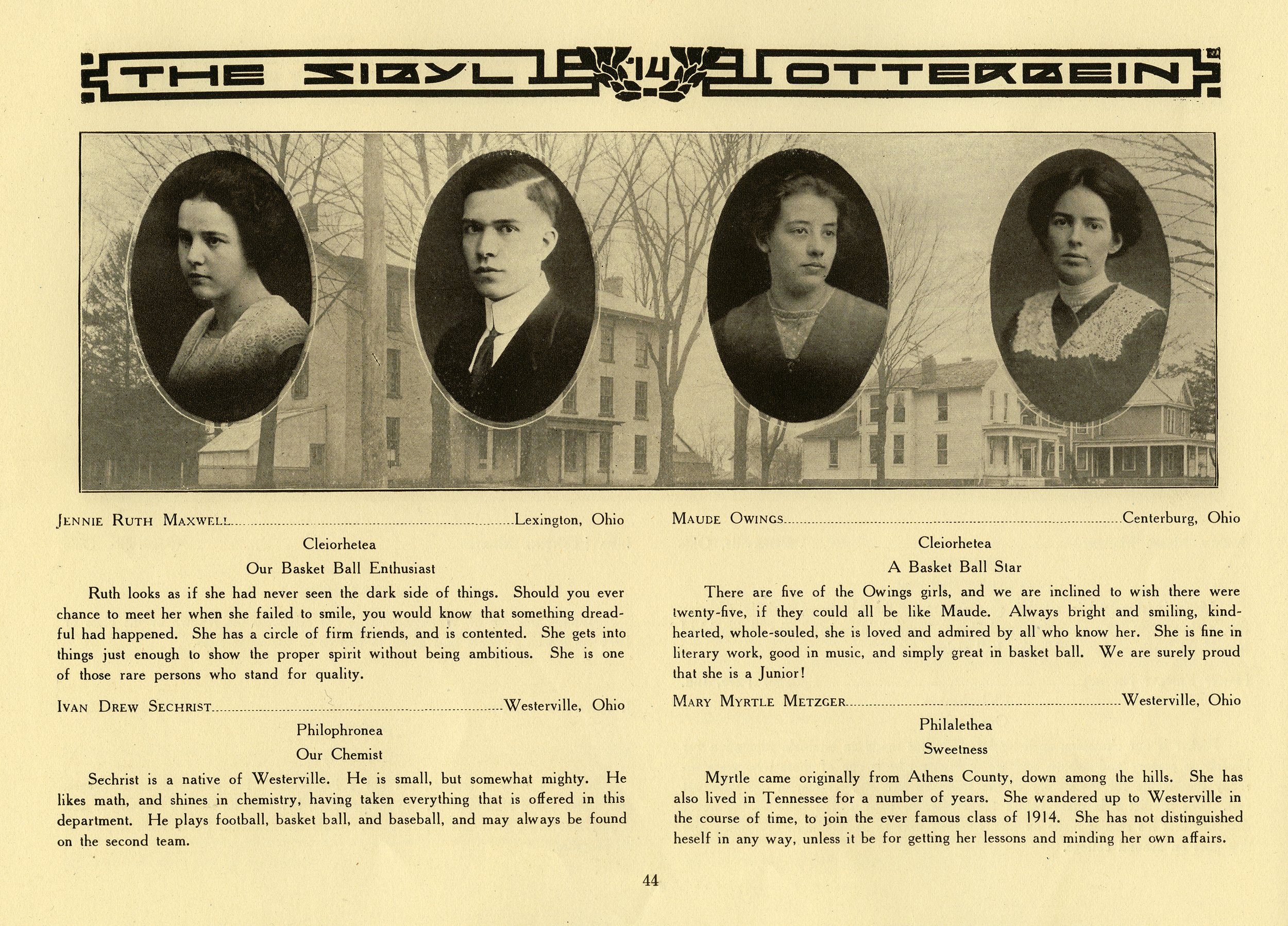
A page from The Sibyl, 1914 edition
[1] Lottie M. Spessard, “Tribute to Myrtle Metzger,” The World Evangel (February 1963), p. 49.
[2] https://www.familysearch.org/ark:/61903/3:1:S3HT-D18V-GG?view=index&personArk=%2Fark%3A%2F6
[3] %2F1%3A1%3AMSCY-HWH&action=view&cc=1325221&lang=en&groupId=M929-87Q
[4] Spessard, “Tribute,” p. 49;
https://www.familysearch.org/ark:/61903/3:1:33SQ-GRJX-B8G?view=index&personArk=%2Fark%3A%2F
[5] %2F1%3A1%3AML6M-J27&action=view&cc=1727033&lang=en&groupId=
[6] The Sybyl, IX (1913), p. 44.
[7] Otterbein University Bulletin, 1914, p. 131.
[8] Spessard, “Tribute,” p. 50.
[9] Tan and Cardinal, February 4, 1918.
[10] Myrtle Metzger to Samuel Zeigler, 2 July 1922, TLS, 2279-2-1:4 Correspondence 1922, Records of the Church of the United Brethren in Christ; footnote in Kenneth F. Kasperski, Noble Colonials: Americans and Filipinos, 1901-1940 (Dissertation, University of Florida, 2012), pp. 234-35.
[11] Tan and Cardinal, October 13, 1924. 10 Spessard, “Tribute,” p. 50.
[12] Ibid; https://iamjoannroyal.wordpress.com/tag/united-church-of-christ-kiangan/; Tom Steffen, “Global Implications of Western Education on the Antipolo/Amduntug Ifugao,” International Journal of Frontier Missions (Vol. 15-2 April-June 1998), pp. 1-10.
[13] Otterbein Towers, January, 1932; Myrtle Metzger, “Thanksgiving and Shadows in Ifugao,” The Evangel (Vol. 53, June 1934), pp. 211-12.
[14] M. Myrtle Metzger, “A Tribute to the Filipinos of Ifugao,” Telescope-Messenger, July 19, 1947.
[15] Spessard, “Tribute,” pp. 50, 61; Otterbein Towers, June 1945; Telescope-Messenger, July 19, 1947. 15 Mrs. S. S. Hough, Faith that achieved : a history of the Women's Missionary Association of the Church of the United Brethren in Christ, 1872-1946 (Dayton?: Women's Society of World Service of the Evangelical United Brethren Church, 1958), p. 88.
[16] Otterbein Towers, December1953 and December 1954.
[17] Spessard, “Tribute,” p. 49. 18 Ibid, p. 61.