
More Stories of George Stoughton
A couple of issues ago, I focused on George Stoughton (1872-1936), who served as mayor of Westerville, and later as postmaster. Shortly after that article appeared, I happened upon two more stories in which Stoughton played a part. Neither story is particularly earth shattering, but both illustrate that the first years of the twentieth century was a time of changing attitudes toward leisure. In the month of Valentine’s Day, leisure often meant mailing greeting cards, and what better way to use mail than to foster a romance?
Waiting for the Mailman
Although we no longer crave visits from our friendly neighborhood postal employee as we once did, many of us at least have memories of waiting for the daily delivery of mail. Whether it was the latest Sears catalog or tidings from a distant relative, the mail was (or seemed) a much-awaited goal for those of us who grew up before the Internet.
Surprisingly, perhaps, home delivery of mail was an innovation of the now vanished twentieth century. Rural Free Delivery was a luxury made nationwide in 1902, and a few urban centers had home delivery in the late nineteenth century. Small town America had to wait for individual, progressive postmasters to lead the way. Such a one was George Stoughton. Before that, customers expecting mail had to go in person to the post office; if no mail was forthcoming, there was no option other than trying again another day.
In Westerville, mail delivery began in 1912. An announcement of the new service was made in the Otterbein Review, headed, “Students Rejoice,” hinting at the expectations of Otterbein students. The article proclaimed that Postmaster Stoughton had arranged for free home delivery beginning November 13, 1912. Students would be “spared many anxious and disappointed tramps to the post-office.”[1]
Vacationing at Lakeside
Among the visitors and recent visitors at Lakeside from Westerville, are. . . . Postmaster George L. Stoughton and family. . . . .2
If you’ve never been to Lakeside, Ohio, it’s worth a trip for those of us who are mindful of history. Lakeside is a Lake Erie resort on Catawba Island that has preserved the charm of a Chautauqua or church camp. Founded in 1873 by the Methodist Church, it is still church run, but instead of pup tents, visitors may rent Victorian mansions; instead of constant online blare, the town offers wholesome lectures, concerts, and classes. The affiliation with Methodism made, and makes Lakeside a popular destination for Westerville getaways.
The need to “get away” and take a vacation was a symptom of the increase in leisure time, courtesy of the machine age. In earlier times, when the only power was human and horse, work did not leave much time for relaxation. But as railroads, and then automobiles, made workdays shorter, leisure time activities were found to fill the gap. United Brethren from Westerville found at Lakeside a temperate, useful way to kill time. Eleven families from Westerville were at Lakeside, and George Stoughton may have found time to jaw with Rudy Wagoner, Otterbein professor and notorious wit, who was also at Lakeside that summer of 1913.[1]
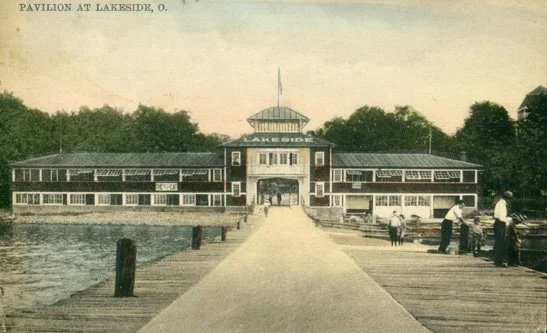
Pavilion at Lakeside, Ohio
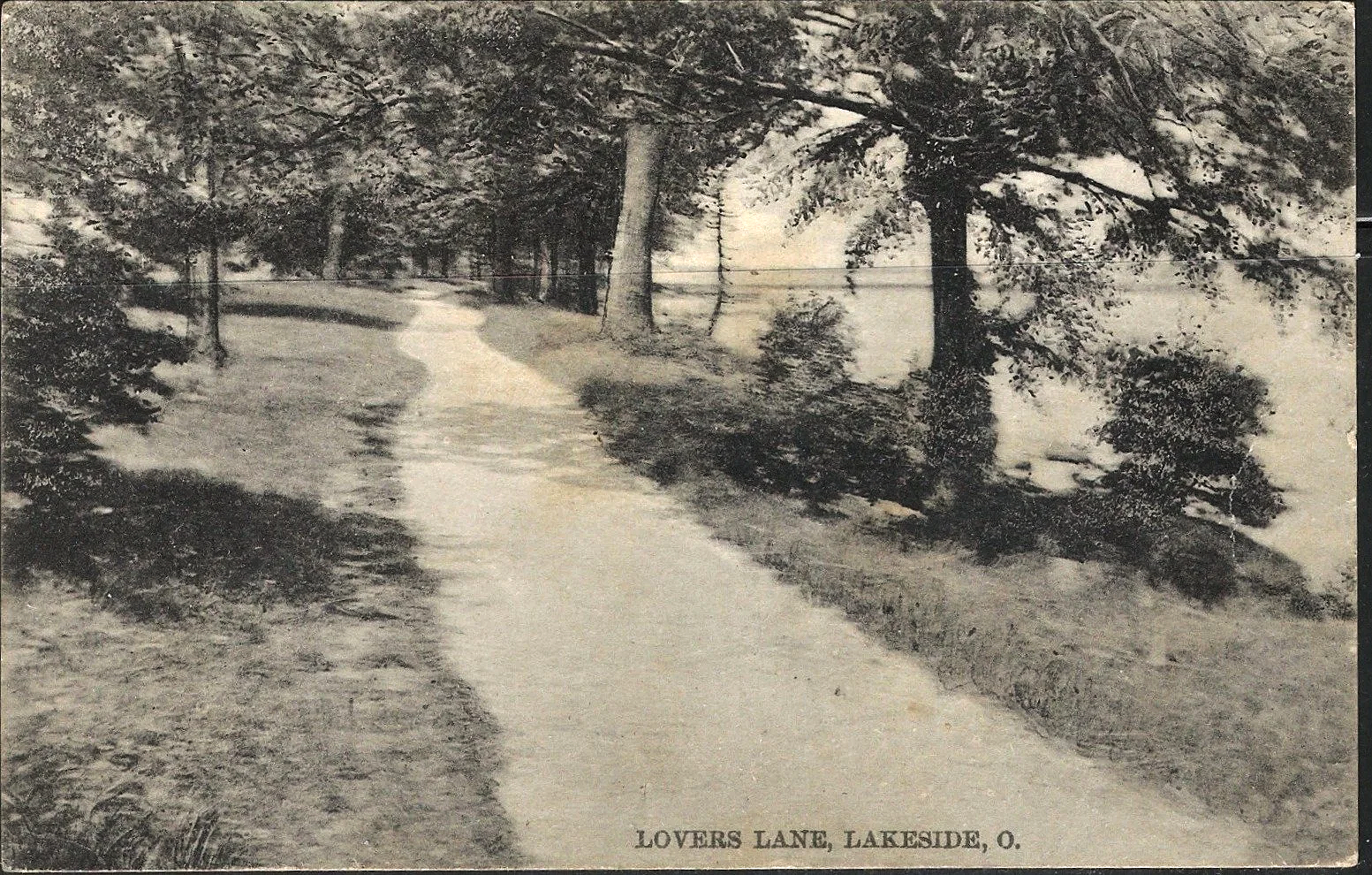
Lovers Lane, Lakeside, Ohio